










PLM in the Cloud or On the Ground? Choosing What Works for You
PLM in the Cloud (SaaS PLM) or On the Ground? Choosing What Works for You
Over the years, we have all seen how PLM has shifted from being an “Engineering Tool” to becoming the central nervous system of an entire business. What used to be a system for managing CAD files and engineering changes is now a platform that connects design, manufacturing, supply chain, quality control, compliance and many. From the first sketch of a product to its retirement from the market, PLM touches every step of the journey.
But as our dependence on PLM has grown, so has the importance of deciding how we deploy it. Sooner or later, most companies have to answer the same big question: do we run PLM in the cloud as a Software-as-a-Service (SaaS) solution, letting the vendor handle the infrastructure and updates? Or do we keep it on our own servers, under our direct control, as an on-premise installation?
It is not a question with a one-size-fits-all answer. The choice affects how quickly one can respond to change, how secure and compliant one can be, how much flexibility one have to adapt the system, and how much the teams can focus on their real work instead of managing technology. This is why the decision deserves careful thought.
What SaaS PLM Feels Like
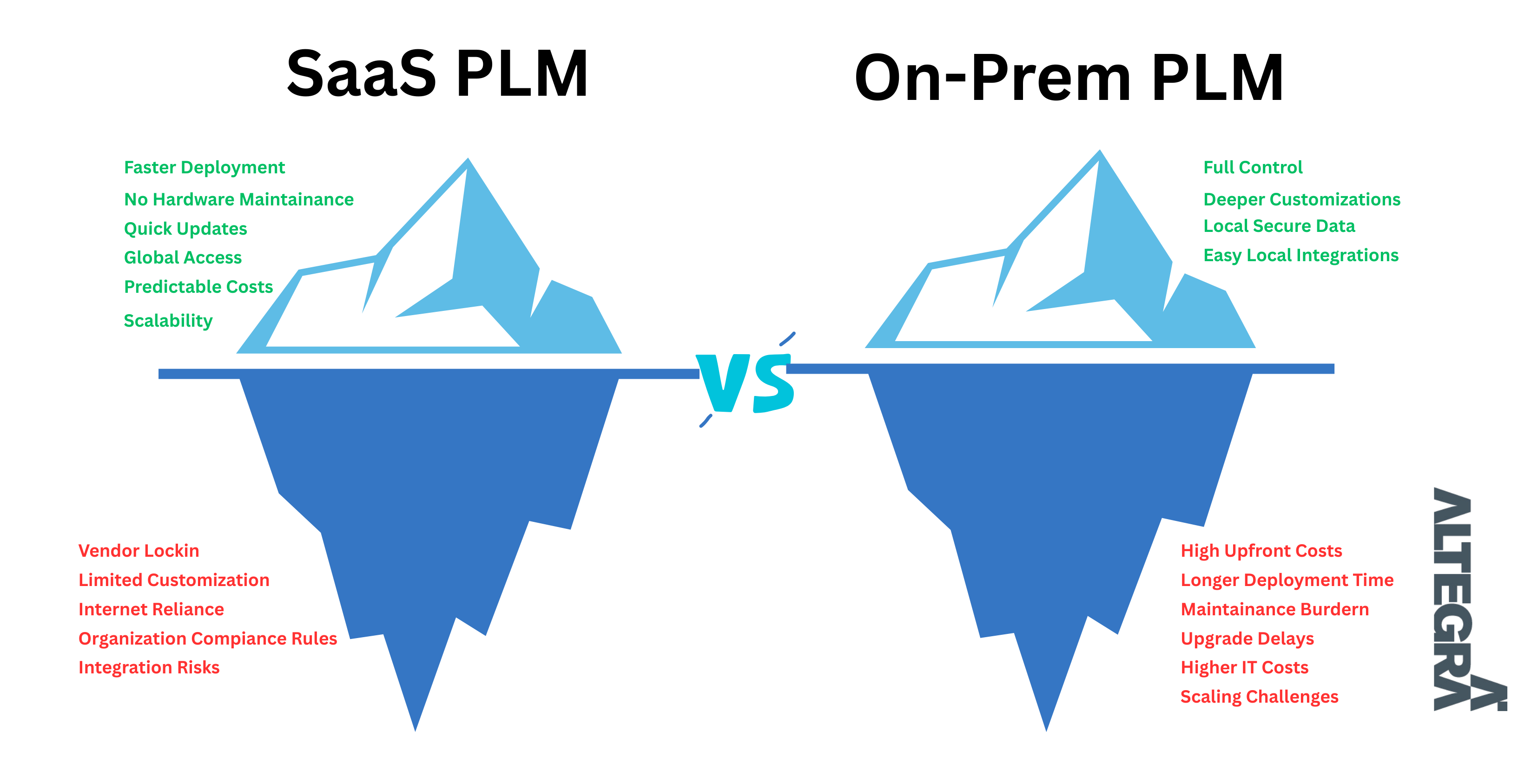
When we go for SaaS PLM, we are essentially asking the vendor to do the heavy lifting. They host it, keep it running, apply updates, back it up, and make sure it scales when we need it to. We log in from anywhere, and the system is just there.
The first thing we notice is speed. Deployment can happen in weeks, sometimes even days, depending on how much data we need to migrate. The costs feel more predictable because we pay a subscription rather than investing in servers and IT support up front.
The trade-off? We play by the vendor’s rules. Deep, custom code changes are usually off the table. Instead, we work with configurations and approved extensions. For many companies, that is a fair deal, fewer headaches in exchange for fewer possibilities to break things.
What On-Premise PLM Feels Like
On-premise lies on the opposite end. The PLM system lives on the company’s infrastructure. The company decides when to upgrade, how to secure it, and how much to customize. We can bend the system to our will — which can be a blessing and a curse.
It is the route companies often take if their industry is heavily regulated, or if the company has unique processes that would be difficult to replicate in a cloud platform. But companies must be ready for the commitment. Hardware, skilled IT staff, testing environments, they all need time and budget.
How PLM Vendors Are Approaching It
Most major PLM vendors now walk both paths, but if we look closely, they are all leaning toward the cloud.
- PTC is pushing Windchill+ for those of us who want a managed cloud experience, but they still support the classic on-premise Windchill for industries that cannot move yet.
- Siemens offers Teamcenter X as a cloud option while keeping the on-premise version for aerospace, defense, and similar sectors.
- Dassault Systèmes runs 3DEXPERIENCE in the cloud and on-premise, making it easier for companies to shift gradually.
- Aras gives us Enterprise SaaS subscription model or the classic on premise installation.
How We Can Decide
The best starting point is to be brutally honest about what we need in the next year or two. If speed matters most, if we want predictable costs, and if our IT team is already stretched, SaaS makes life easier.
If we need tight control, deep custom logic, and have the infrastructure and IT team ready, on-premise installation could be the safer long-term play.
Budget style matters too. With SaaS, we spread the cost over time in predictable monthly or annual subscriptions. That makes budgeting easier and keeps the upfront investment low. For many companies, that steady cost model is less risky, especially when the are scaling up or trying PLM for the first time.
On-premise, on the other hand, Once the system is running, the ongoing costs might be lower than SaaS, especially if we are running it for many years without major upgrades. The key is knowing whether we can actually sustain it without cutting corners on maintenance or security.
Integration is another piece of the puzzle. If the company’s ERP, MES, and other enterprise tools are already cloud-based, a SaaS PLM will usually fit in more naturally. Data can flow between systems without complicated VPNs, custom middleware, or constant network troubleshooting. But if the key systems are still on local servers, companies might find on-premise PLM easier to connect.
Dealing with the Challenges
With SaaS, the main worry is vendor lock-in. Companies can address that by negotiating clear data export rights and regularly testing the ability to pull data in usable formats.
For on-premise, the big risk is falling behind on upgrades. A sensible upgrade schedule, even if it is just once a year, keeps companies from facing massive changes all at once.
Choosing between SaaS and on-premise PLM is not about picking the “better” technology. It is about picking the one that fits the way the organization works today and supports the direction the company want to move in tomorrow.

My focus is on helping organizations optimize their product lifecycle processes, enhance collaboration, and achieve sustainable growth through effective PLM strategies. Dedicated to delivering value, I strive to empower clients to overcome challenges and achieve their business goals.