









Bringing Better Quality to PLM Implementations and Testing the Digital Thread
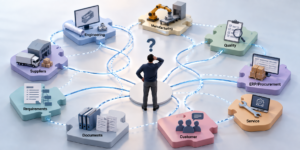
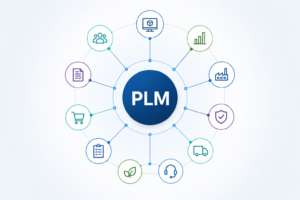
PLM Implementations has changed significantly over the years. What was once mainly a system for managing product data, CAD drawings, documents and engineering changes has become an important part of a much larger digital landscape. Today, PLM is connected to multiple upstream and downstream systems, supplier platforms, reporting solutions and many other applications that together support the product lifecycle. We often describe this connected flow of information as the Digital Thread, and while this connectivity brings enormous value to an organization, it also makes quality assurance much more challenging.
A change made in one part of the PLM solution can have consequences somewhere completely different in the enterprise landscape, which means testing can no longer focus only on whether a particular screen, button or workflow inside PLM is working correctly.
At Altegra, we have been working closely with our customers implementing PLM solutions and the surrounding enterprise landscape, and this is one of the reasons we see strong value in modern test automation platforms such as Testsigma.
For us at Altegra, the interesting part is not simply the possibility of replacing manual test cases with automated ones. The bigger opportunity is where critical PLM processes and Digital Thread integrations can be tested repeatedly as the solution evolves. When this is combined with AI-assisted automation, testing can become easier to create, easier to maintain and much more closely connected to the way modern PLM implementations are performed.

PLM Testing Is No Longer Only About PLM
A typical PLM business process rarely starts and ends inside a single application. For an ECO in Aras innovator or Teamcenter, a change request begins with an engineer creating or modifying a part information in PLM continues through workflow approvals involving several roles, and finally the information is sent to ERP, manufacturing or another downstream systems. From a business perspective this is just one process, but technically it may involve workflows, permissions, business rules, APIs, integrations, background jobs, database transactions and multiple applications. Testing only the PLM UI with buttons and textboxes therefore tells us only part of the story.
Another aspect that is overlooked in PLM testing is browser compatibility. Especially when custom solutions are introduced, these are accessed by users through different browsers, and something that works correctly in Chrome does not automatically mean it works in Microsoft Edge or othersupported browser. A page may render differently or a JavaScript-based function may react differently after a browser update, or a simple enterprise browser policies may influence the code behind.
The purpose of the Digital Thread is to maintain a reliable flow of product information between different stages of the lifecycle, and the quality of that thread depends on every data connections along the way. A PLM tool may correctly release a new part revision, but that does not mean that ERP received the right data, that manufacturing received the correct BOM structure, or another downstream application understood the information as expected.
A process can therefore appear successful from the PLM user’s perspective can still fail somewhere later in the Digital Thread. Good testing needs to follow the business process beyond the boundaries of one system.
Why Manual Regression Testing Becomes Difficult
Manufacturing organizations already perform manual regression testing by the key users, but the challenge is the amount of effort required to repeat it consistently. PLM solutions contain years of configurations, customizations, workflows, integrations and business rules that have become critical to the organization. When a new feature, service pack or customization is introduced, teams need to verify that the new functionality works while also making sure that existing processes have not been affected. The larger the PLM solution becomes, the larger this regression scope becomes as well.
Manual testings works well for basic testings and for situations where human judgement is important, but it is not so efficient when the same scenarios need to be repeated over and over for every change introduced . A tester may need to create an item, populate its attributes, move it through lifecycle states, change user roles, approve a workflow, validate a structure and then verify whether information reached another system correctly. Performing this manually for hundreds of scenarios takes considerable time, and when release schedules become tight, teams must prioritize on what is important and what is not. This creates the possibility that a unrelated process to the change is not tested thoroughly enough, and a regression issue reaches production.
Test Automation Creates a Quality Safety Net
Over the years it has become evident, test automations brings a different level of value to PLM implementations. Once important business scenarios are automated, they can be executed repeatedly whenever the solution changes. Instead of deciding during every release which regression tests can be performed under available time, organizations can gradually build a reusable set of test cases covering their most important processes. Over time, this becomes a quality safety net around the PLM solution itself.
The biggest advantage is not simply that an automated test can execute faster than a person. The real advantage is consistency and repeatability. The same process can be tested using the same steps, the same validations and the same expected results after every new change.As the automated regression suite grows, confidence in the release process can grow with it.
This is particularly useful in PLM environments because many problems are not caused by completely new functionality. They are caused by changes that unexpectedly affect something that has been working for years. Automated regression testing helps detect these problems much earlier.
Why We Choose TestSigma at Altegra
One of the reasons we think Testsigma is valuable, is its approach to making test automation more accessible. Traditional test automation frameworks can be very powerful, but they often require people with specialized programming and automation skills to create and maintain the test suites. In PLM projects, however, some of the people who understand the processes best are PLM consultants or business process specialists rather than dedicated test automation developers. These are the people who understand what should happen in the process when an engineering change is approved, which information should be transferred to ERP, which lifecycle states are important and which combinations of permissions can create business problems.
Reducing the technical barrier between this process knowledge and automated testing is therefore valuable. A platform such as Testsigma allows teams to approach automation at a higher level, making it easier for people with strong functional knowledge to participate in defining and maintaining automated tests.
This does not remove the need for technical expertise, especially when complex integrations and enterprise scenarios are involved, but it can bring the people who understand the business process much closer to the automation itself. For PLM, where business logic and technical implementation are often deeply connected, that is an important advantage.
Testing the Digital Thread Instead of Individual Systems
Another area where we see strong potential is moving from application testing towards business-process testing across the Digital Thread. Traditionally, different teams may test PLM, ERP and other systems independently. Each system may pass its own tests, while the end-to-end process between those systems can still fail. From the business user’s perspective, however, it does not matter that each individual application technically passed its tests if the overall process does not work. This is where we see Testsigma can be used to test multiple web based enteprise applications or applications that supports APIs can be tested under one unified platforms and easy to manage.
How AI Changes Test Automation
Test automation itself is not new, but maintaining automated tests has traditionally required significant effort. Enterprise applications change regularly. User interfaces are updated, fields are moved, labels are changed, new versions of applications are introduced and integrations evolve. Automated tests that depend heavily on specific UI elements or technical structures can break even when the actual business process is still valid. When this happens frequently, maintaining the automation can start consuming a significant part of the testing effort.
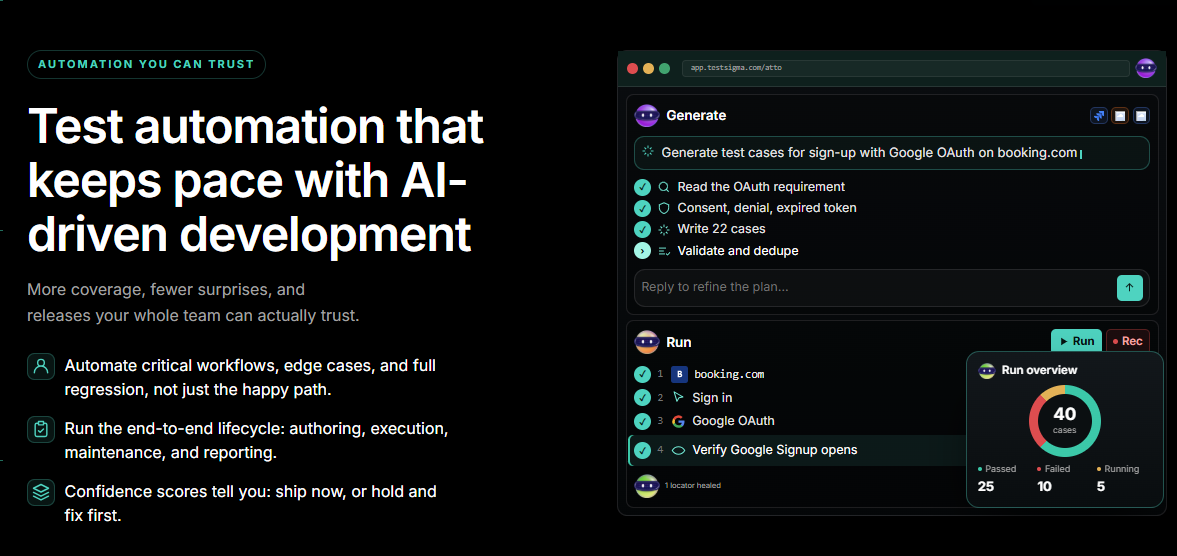
AI changes this picture. AI-assisted testing can support activities such as generating test cases from business requirements, helping identify application elements, auto healing tests when UI changes, analysing failed executions and assisting users in understanding why a test has failed. Instead of expecting testers to manually handle every repetitive part of automation development and maintenance, AI can take care of more of the mechanical work while business users concentrate on understanding the process and the business risk.
This is also why we believe AI in testing should not be viewed simply as another AI feature added to a product. Its real value appears when it reduces the effort required to create and maintain useful automation
AI Supports the Tester, but PLM Knowledge Still Matters
There is an important balance to maintain. AI may help generate a test, analyse a failure or adapt automation when an application changes, but it does not automatically understand why a particular PLM process is critical to a company. It does not know why one lifecycle transition requires a specific validation, why a particular attribute must reach ERP before manufacturing can continue, or what the business impact would be if an incorrect revision were released.
That understanding still comes from people who know the product development process and the PLM landscape. AI can then help make the process of turning that knowledge into repeatable automation much more efficient.
For us at Altegra, this is why Testsigma is interesting. It connects well with the direction in which PLM itself is moving, more integration, more frequent change, more automation and a greater need to ensure that the complete Digital Thread continues to work reliably with a right balanace of AI touch.

My focus is on helping organizations optimize their product lifecycle processes, enhance collaboration, and achieve sustainable growth through effective PLM strategies. Dedicated to delivering value, I strive to empower clients to overcome challenges and achieve their business goals.